How To Get Around Ho Chi Minh City
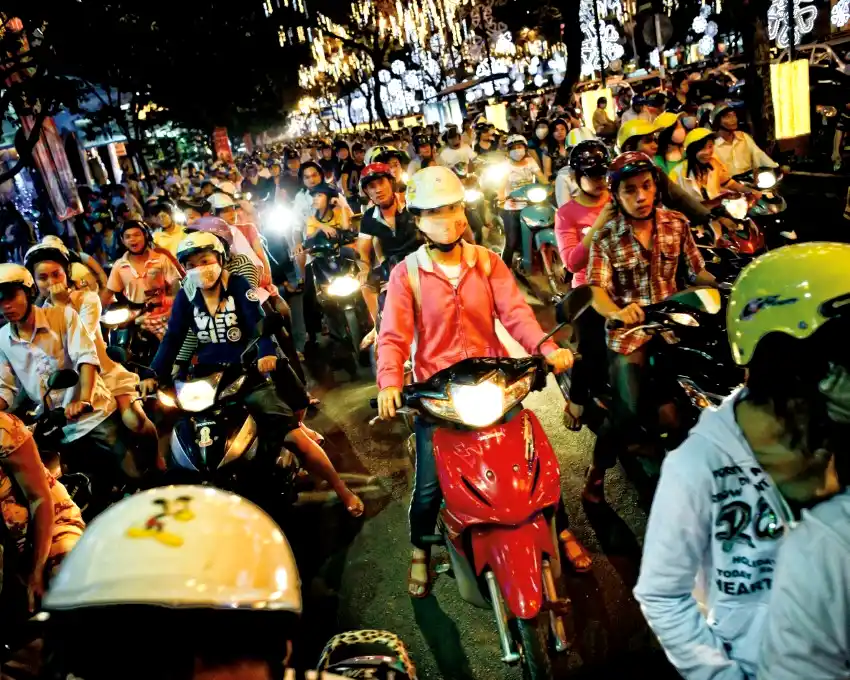
The first time you step outside in Ho Chi Minh City and watch a river of motorbikes pour through an intersection, it is genuinely hard to know where to begin. But here is the thing: the traffic only looks chaotic from the pavement.
Once you are in it, either on the back of a bike or inside an app-booked car, it makes complete sense. Getting around Saigon is cheap, fast, and surprisingly easy once you know which tools to use. And the tools are very, very good.
The Quick Summary:
- Best Transport: Ride-hailing apps. Fixed prices, no language barrier, and they work everywhere across the city.
- Daily Budget: 70,000 to 150,000 VND ($2.85 to $6.15 USD) covers most short to medium trips comfortably.
- Best for Walking: District 1, specifically around Nguyen Hue Walking Street and Dong Khoi. Everywhere else, take a bike.
- Key Apps to Download: Grab, Xanh SM, and Be. Get these on your phone before you land.
- Metro Line 1: Now open and running between Ben Thanh and Suoi Tien. Useful for some routes, not yet a city-wide solution.
Transport Options at a Glance:
There is no single right answer for getting around. A solo traveller zipping between cafes has completely different needs to a family arriving from the airport with four suitcases. Here is how the main options stack up before we dig into each one.
| Transport Type | Average Cost (VND / USD) | Best Used For |
|---|---|---|
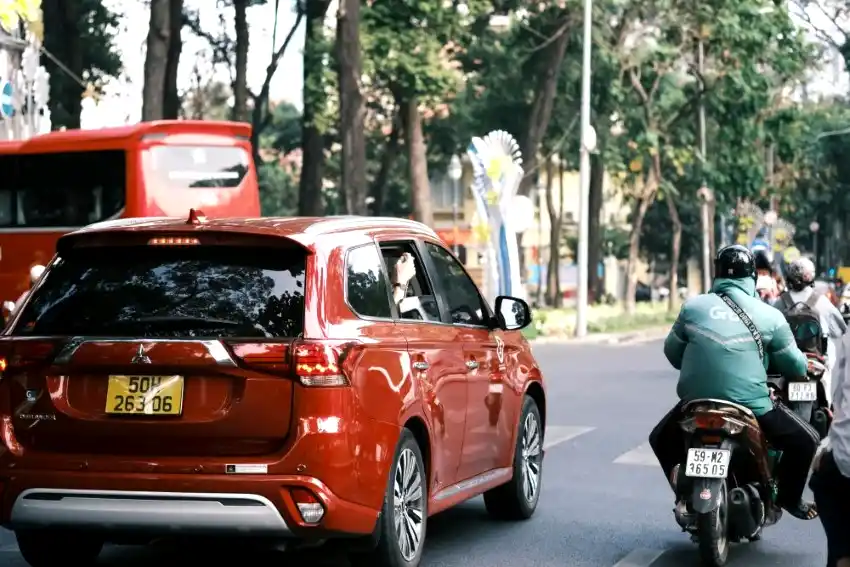
| Ride-Hailing Motorbike (Grab / Be / Xanh SM) | 15,000 to 40,000 VND ($0.60 to $1.65 USD) | Fast solo trips, cutting through traffic, short to medium distances |
| Ride-Hailing Car or Electric Taxi | 50,000 to 120,000 VND ($2.05 to $4.95 USD) | Groups, luggage, rainy weather, comfortable trips across districts |
| Traditional Metered Taxi (Vinasun / Mai Linh) | ~16,000 VND ($0.65 USD) per kilometre | Airport runs, spontaneous hails when your phone is out of charge |
| Public Bus | 7,000 to 15,000 VND ($0.29 to $0.62 USD) | Long cross-city routes, budget travel, airport transfers |
| Metro Line 1 | ~15,000 VND ($0.62 USD) per journey | Ben Thanh to Suoi Tien corridor, air-conditioned and traffic-free |
Getting Around: Your Full Options
Ride-Hailing Apps: Grab, Be, and Xanh SM
These three apps are the backbone of daily transport in Ho Chi Minh City and the single most important thing to have on your phone. You type in your destination, see the price upfront in Vietnamese Dong, pick your vehicle type, and your driver appears within minutes. No negotiating, no language barrier, no meter-watching. Payment works via linked international cards or cash, and the in-app GPS takes care of directions so you never need to explain where you are going.
Grab has the largest driver network and is the most reliable across all districts. Be is a solid local alternative that often undercuts Grab slightly during peak commuter hours, and is worth having open as a backup when surge pricing kicks in. Xanh SM is the standout choice for anyone who likes their travel low-impact: the entire fleet runs on VinFast electric motorbikes and cars, they are noticeably quiet, and the vehicles are consistently well-maintained. If you want a deeper look at how these two stack up, our Grab vs Xanh SM comparison breaks it all down.
For solo travel, the motorbike option on any of these apps is the fastest way to move through the city. Drivers weave through alleys and past gridlock that would add 20 minutes to a car journey. For groups, luggage, or a sudden downpour, switch to a four-wheeled booking and stay dry. It is one of the things that makes Ho Chi Minh City so addictive as a destination: you are never more than a few taps away from a comfortable, affordable ride.
Traditional Taxis: Vinasun and Mai Linh
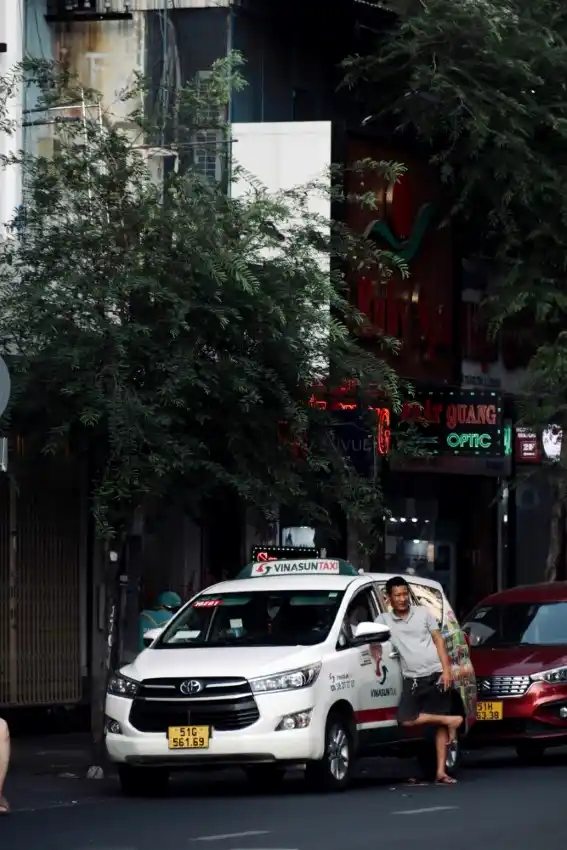
Traditional metered taxis are safe and reliable in Ho Chi Minh City, as long as you stick to the two reputable brands. Vinasun taxis are white with green and red stripes, with the hotline 38 27 27 27 on the door. Mai Linh taxis are bright green with the number 38 38 38 38. Both use calibrated meters and display driver ID clearly inside the vehicle.
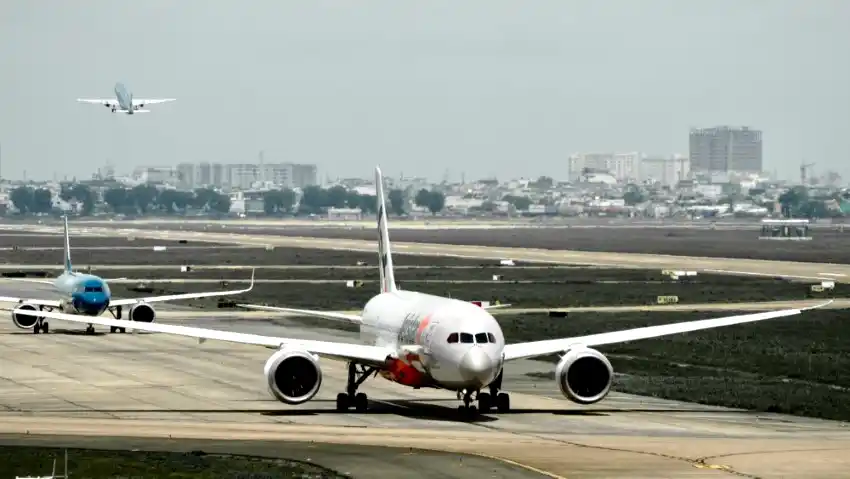
The catch is that rogue operators frequently clone the colour schemes and logos of both companies with subtle differences, specifically to catch airport arrivals off guard. When leaving Tan Son Nhat, skip any drivers shouting in the main concourse entirely. Walk to the official taxi lanes on the far left of the arrivals area, or head upstairs to the designated ride-hailing pickup zones. Always confirm the meter is running before the car pulls away from the kerb. For a broader look at how to handle airport arrivals smoothly, the Vietnam airports guide has you covered.
Airport Tip: The ride-hailing pickup zones at Tan Son Nhat are on the upper floors of the parking garage. Slightly further to walk, but virtually no waiting time and none of the kerb-side hassle of verifying a metered taxi.

Find your perfect base in Vietnam’s most energetic
metropolis. Compare top-rated properties across
central District 1, historic District 3, and the riverside
expat hub of Thao Dien to lock in the best rates
before you travel.
Walking: Where It Works and Where It Doesn’t
Ho Chi Minh City is not a city you can walk across, but it has walkable pockets that are genuinely worth knowing. District 1 is the most pedestrian-friendly area, particularly around Nguyen Hue Walking Street, a wide vehicle-free granite promenade that lights up beautifully in the evening. The leafy streets around the Notre-Dame Cathedral Basilica, the Central Post Office, and Paris Square are pleasant on foot, shaded by mature heritage trees and mercifully free of heavy traffic. If you are staying in District 1 and want to understand the neighbourhood layout before you arrive, the where to stay in Ho Chi Minh City guide maps out exactly which pockets suit which type of traveller.
Outside these clusters, pavements become uneven, are frequently occupied by parked motorbikes, and the kerbs are high enough to trip you up if you are not paying attention. For everything beyond a 10-minute stroll, a ride-hailing bike is always the better call. And while you are on foot in District 1, the things to do in Ho Chi Minh City page has plenty of ideas within easy walking distance of each other.
Crossing the Street: Step off the kerb calmly, keep a slow and completely predictable pace, and make eye contact with the flow of traffic. Local riders will read your trajectory and move around you. Never stop suddenly mid-crossing and never bolt backwards. Within a day or two it becomes second nature, honestly.
The Public Bus: Slow, Cheap, and Surprisingly Useful
The public bus network is not the fastest way to get anywhere, but for travellers on a tight budget it is excellent value. Fares run from just 7,000 to 15,000 VND ($0.29 to $0.62 USD) depending on the route. Download the BusMap app before you board: it shows real-time tracking, stop locations, and route maps that make navigating the network far less intimidating than it looks at first glance. If keeping costs low is a priority, our Vietnam budget travel guide pairs well with this.
Two routes worth knowing: Route 109 runs directly between Tan Son Nhat International Airport and the Saigon Bus Station near Pham Ngu Lao, making it one of the cheapest airport transfers in Southeast Asia. Route 1 connects Ben Thanh Market with the Cho Lon Chinatown district in District 5, passing through some brilliant local street food territory along the way. If that last stretch whet your appetite, the Ho Chi Minh City street food guide will point you to all the good stuff. Board through the front door, pay the conductor in cash, and offer your seat to elderly passengers or monks.

The Practical Toolkit:

- Stay Connected: A live internet connection is essential for ride-hailing and maps. Pick up a local SIM at Tan Son Nhat Airport on arrival, or activate a Yesim eSIM before you land so you are online the moment you clear immigration. You can set it up from home and have data the second your plane touches down. Our Vietnam SIM cards and internet guide covers all your options in full. Use NordVPN when connecting to cafe or hotel Wi-Fi to keep your banking and personal data secure.
- Cash for Short Trips: Keep a supply of 20,000 and 50,000 VND notes for bus fares and street purchases. Drivers on short trips often cannot make change for a 500,000 VND note, so smaller denominations save everyone the hassle. The Vietnam currency guide explains ATMs, cards, and which banks charge the least.
- Travel Insurance: If a motorbike ride ends unexpectedly or a bag gets snatched near the kerb, you want cover in place. SafetyWing is flexible, affordable, and popular with long-term travellers across Southeast Asia. Sort it before you fly.
- Renting a Motorbike: You can legally ride anything under 50cc without a licence, though these lack real power for city traffic. To ride a standard motorbike legally you need a valid International Driving Permit with a motorcycle endorsement from your home country, plus local insurance. Most visitors find it easier and far more enjoyable to hire a driver and take in the city from the back. If you are serious about riding, the renting motorbikes in Vietnam guide covers everything you need to know legally and practically.

Forget the daily data limits of standard tourist SIMs.
Get a Yesim eSIM for unlimited 5G data from ~$10.
Work, stream, and be connected the second you land.
The Metro: Finally, Actually Open
After roughly 15 years of construction delays, cost overruns, and becoming something of a national punchline, Metro Line 1 is now operational. The line runs from Ben Thanh Market in the heart of District 1 all the way northeast to Suoi Tien Theme Park, with 14 stations in total. Fares sit around 15,000 VND ($0.62 USD) per journey, trains run on time in air-conditioned comfort, and the whole experience feels genuinely futuristic compared to sitting in gridlock on the back of a Grab bike.
For most visitors based in District 1 or District 3, the metro is not yet the go-to for everyday trips around the city: the line covers a specific northeast corridor rather than the full urban spread. But if you are heading to Suoi Tien, the University of Technology area, or want a cheap, traffic-free ride to explore a new neighbourhood, it is absolutely worth using. Keep checking local news during your visit as the network is still being extended. For everything else, the apps and buses have the city well covered.
Getting Out of the City: Day Trips and Onward Travel
Once you have the city sorted, the region around Ho Chi Minh City is brilliant for day trips. The Mekong Delta, the Cu Chi Tunnels, and the black sand beaches of Vung Tau are all within striking distance. The easiest way to do any of these without the stress of arranging transport yourself is through Get Your Guide or Klook, both of which have a solid range of guided day trips with English-speaking guides and return transfers baked into the price. The Ho Chi Minh City day trips page runs through the best options and what each one is actually like.
For longer journeys up the coast or towards Da Nang and Hoi An, the sleeper bus network is excellent value and far more comfortable than it sounds. Book seats through 12GO to compare routes and operators without the hassle of turning up at a bus station. If you are piecing together a longer trip through the country, the how to get around Vietnam guide covers trains, buses, and domestic flights in full. And if you are still figuring out your full route, the north to south Vietnam itinerary is a solid starting point.
For airport transfers, Welcome Pickups offers fixed-price, pre-booked private transfers to and from Tan Son Nhat. No meter anxiety, no negotiating in arrivals, and your driver is waiting with a name board. Worth it on a long-haul arrival when you just want to get to your hotel.
A Note for Nervous Travellers:
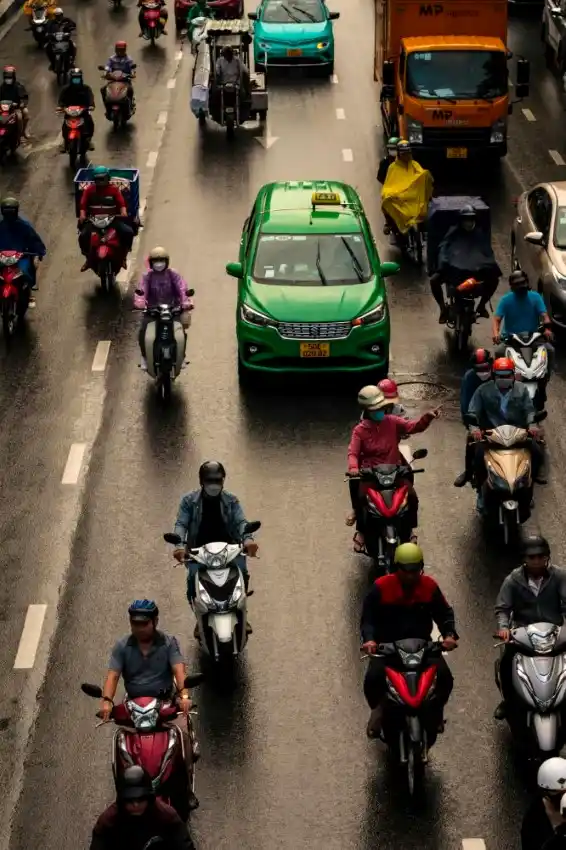
The traffic volume is the biggest initial shock for most visitors, and that reaction is completely understandable. What looks like chaos from the pavement actually operates on a cooperative logic: everyone is watching everyone else, speeds are moderate, and the whole system flows because of it rather than despite it. Step in calmly, move predictably, and trust the process. You will be fine within half a day.
The one genuine security concern worth flagging is phone and bag snatching from moving motorbikes near busy tourist corridors. It is not common, but it does happen. Keep your phone put away when you are standing near the kerb, wear bags on the side away from the road, and avoid dangling camera straps at street level. Inside a ride-hailing car or on foot in a pedestrian zone you can completely relax. A bit of basic street awareness is all it takes. For a fuller picture of what to actually watch out for, the Vietnam safety guide and the is Vietnam safe overview are both worth a read before you travel.
Find your perfect base in Vietnam’s most energetic
metropolis. Compare top-rated properties across
central District 1, historic District 3, and the riverside
expat hub of Thao Dien to lock in the best rates
before you travel.
Frequently Asked Questions:
Is there a working metro or subway system in Ho Chi Minh City?
Yes. Metro Line 1, connecting Ben Thanh Market to Suoi Tien Theme Park across 14 stations, is now open and carrying passengers. It covers a northeast corridor through the city and is a useful, air-conditioned alternative to sitting in traffic for that specific route. It does not yet serve the full city, so for most trips you will still rely on ride-hailing apps and buses.
How much does it cost to get around Ho Chi Minh City per day?
Most visitors spend between 70,000 and 150,000 VND ($2.85 to $6.15 USD) on transport in a typical sightseeing day. A motorbike ride-hail across central districts costs 15,000 to 40,000 VND, a car ride runs 50,000 to 120,000 VND, and the public bus costs just 7,000 to 15,000 VND. If you are mostly staying in District 1 and walking between sights, you could easily spend very little at all.
How much should I tip drivers in Ho Chi Minh City?
Tipping is not expected for standard transport in Vietnam. For ride-hailing or metered taxi drivers, rounding up to the nearest 10,000 VND is a kind gesture, and leaving 20,000 VND for a driver who helps with heavy luggage or goes well out of their way is always appreciated. It is never obligatory.
Can international tourists legally rent and ride a motorbike?
You can legally ride anything under 50cc without a licence, but these smaller bikes struggle in city traffic. To ride a standard motorbike legally you need a valid International Driving Permit with a motorcycle endorsement from your home country, plus local insurance. Many visitors find it easier and more enjoyable to book a ride-hailing motorbike and let someone else navigate.
Which app is best for getting around: Grab, Be, or Xanh SM?
All three are reliable and worth having installed. Grab has the largest driver network and is the most consistent across all districts. Be often comes in slightly cheaper during peak hours. Xanh SM is the best choice if you want an electric vehicle and consistently well-presented drivers. In practice, most regular visitors use all three depending on wait times and pricing at any given moment.
What is the cheapest way to get from the airport to the city?
Bus Route 109 runs directly from Tan Son Nhat International Airport to the Saigon Bus Station near Pham Ngu Lao for just 7,000 to 15,000 VND. It is the cheapest option by a wide margin and perfectly straightforward with the BusMap app. For a faster and more comfortable arrival, a ride-hailing car from the upper-floor pickup zone costs around 80,000 to 120,000 VND ($3.30 to $4.95 USD) to most central districts.
Is it safe to take a motorbike taxi in Ho Chi Minh City?
Yes, ride-hailing motorbike taxis through Grab, Be, or Xanh SM are safe and are the standard way locals and visitors get around. The apps track your route and share it with the driver-rating system, which keeps standards high. The main precaution is to wear the helmet your driver provides and keep your bag in your lap or held close rather than swinging from one shoulder.
Do I need to speak Vietnamese to get around Ho Chi Minh City?
Not at all. The ride-hailing apps handle destination-setting entirely through GPS and in-app maps, so you never need to say a word. For traditional taxis, showing the destination on Google Maps works fine. Most drivers are used to foreign passengers and will confirm the route visually. The BusMap app handles public bus navigation in English too.
What is the best way to get from Ho Chi Minh City to the Mekong Delta or Cu Chi Tunnels?
The easiest option is a guided day trip booked through Get Your Guide or Klook, with transport included in the price. These typically run 400,000 to 800,000 VND ($16.50 to $33 USD) depending on the destination and group size, and save you the hassle of arranging bus connections independently. Self-guided trips are possible by public bus or sleeper bus for budget travellers, but the guided option is genuinely excellent value given how much ground is covered.
Is it worth renting a car in Ho Chi Minh City?
For most visitors, no. Self-driving in central Ho Chi Minh City is genuinely stressful even for experienced drivers, parking is a headache, and the ride-hailing options are so cheap and convenient there is little reason to bother. Renting a car with a private driver for a full day is a different matter and makes good sense for longer excursions out of the city, such as a day trip to the Mekong Delta or Vung Tau. Prices for a full-day car with driver start around 1,200,000 VND ($49 USD).